Car Logo Meanings
Every car logo tells a story. Some hide a founder's initials, others a city's coat of arms, an animal chosen for speed and power, or a symbol of the company's engineering roots. Here's what the world's best-known car brand logos actually mean — tap any brand for its full history.
156 car brand logos explained
Abarth logo
A shield featuring a stylized black scorpion on a red-and-yellow background with the Abarth name. Founder Carlo Abarth chose the scorpion because it was his astrological sign (Scorpio).
AC Cars logo
The badge is a roundel containing the stylised, interlocked letters 'AC', a contraction of Auto-Carriers, one of the company's early names (Autocarriers Ltd, from 1907). The rounded lettering with its distinctive curling tails has been retained, with only colour and detail refinements, for over a century.
Acura logo
A stylized 'A' formed within a caliper (a precision measuring tool) inside an elongated chrome diamond. It symbolizes engineering precision and Acura's 'Precision Crafted Performance' philosophy.
Alfa Romeo logo
A circular emblem with two symbols of Milan, where the brand was founded: a red cross on white (the city's coat of arms) and a crowned serpent (biscione) devouring a man, the heraldic emblem of the Visconti dynasty.
Alpina logo
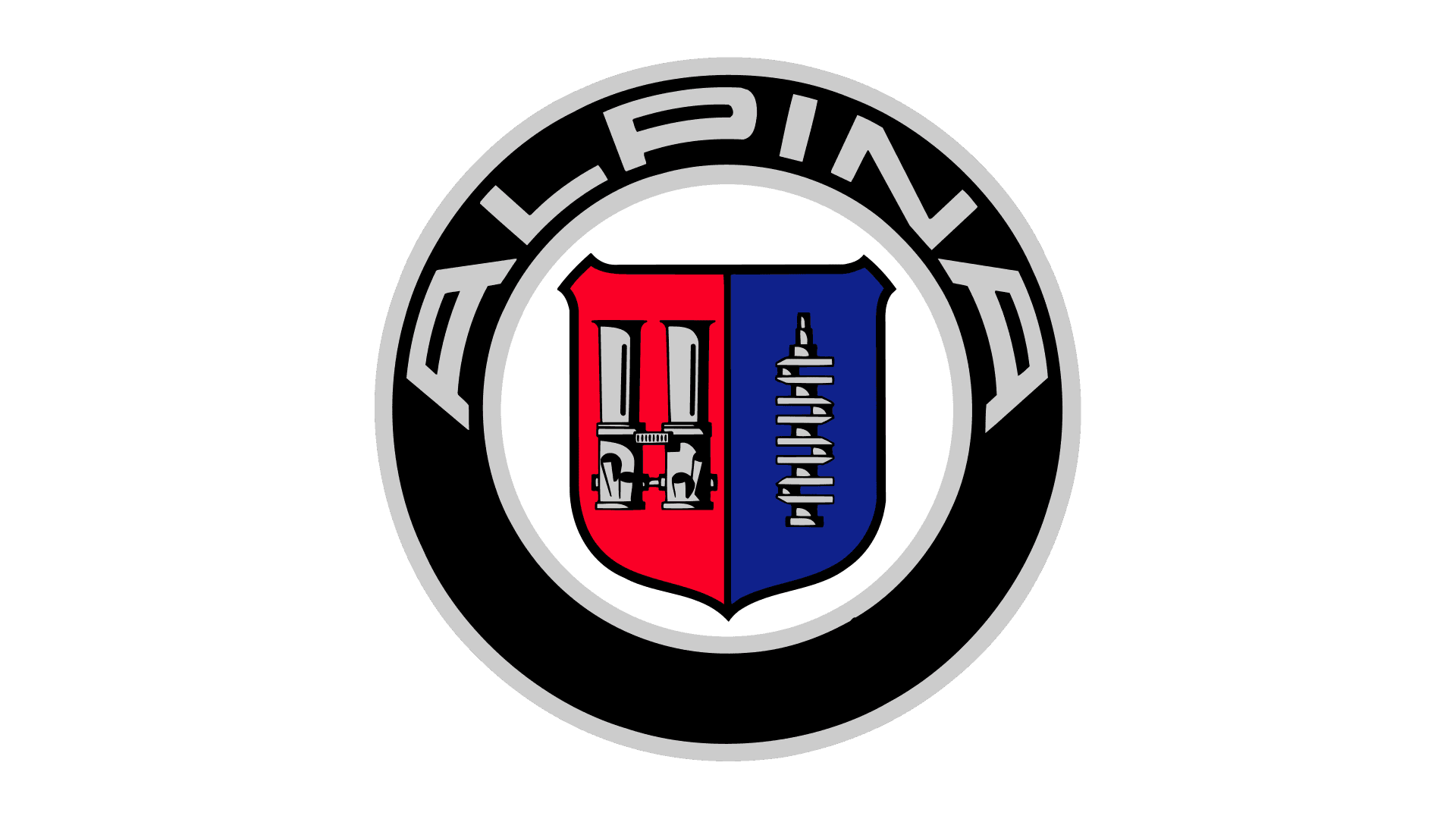
The crest is split between two emblems that defined Alpina's early work: a Weber twin-carburettor on one side and a crankshaft on the other, both components the firm reworked to draw more power from BMW engines. The ALPINA wordmark sits above, with the badge using the marque's blue and red.
Alpine logo
The stylized brand name 'Alpine,' typically rendered in blue. Founder Jean Rédélé chose the name in tribute to his rally successes in the Alps, such as the Coupe/Critérium des Alpes.
AMC (American Motors) logo
The logo is a wordmark of the letters 'AMC', often rendered in a red, white and blue scheme that underlined the firm's American identity. The lettering simply abbreviates the company name, American Motors Corporation.
Ariel logo
The mark carries the Ariel name, a revival of a historic British marque and an allusion to Ariel the airy spirit, a fitting reference for the skeletal, exoskeleton Atom. In keeping with the car's stripped-back, lightweight ethos, the branding is kept deliberately minimal.
Aston Martin logo
A pair of outstretched wings bearing the 'Aston Martin' name, symbolizing speed and refined since 1932 with inspiration from the scarab beetle of 1920s Egyptology. The name combines the Aston Hill Climb with co-founder Lionel Martin.
Audi logo
Four interlocking rings representing the 1932 merger of four manufacturers (Audi, DKW, Horch, and Wanderer) that formed Auto Union. Each ring stands for one of the founding companies.
Austin logo
Austin badges typically carried the Austin name within a circular or shield-shaped emblem, with several versions featuring wings as a motif of speed and freedom common to early motoring marques. The exact device varied across the company's long history.
Bentley logo
A letter 'B' flanked by a pair of spread wings (the 'Winged B'), symbolizing the exhilaration of motion and the brand's speed and racing heritage. The B stands for founder Walter Owen Bentley.
BMW logo
A circle with four blue-and-white quadrants inside a black ring lettered BMW. The blue and white derive from the Bavarian state colors; the popular association with a spinning aircraft propeller is a retroactive myth.
Brabus logo
The Brabus wordmark spells out the company name, which is built from the first letters of its two founders' surnames, Brackmann and Buschmann. It is usually rendered in black or chrome, often with a red accent, projecting a bold, high-performance image.
Bugatti logo
An oval 'macaron' badge with a red border containing the 'EB' initials of founder Ettore Bugatti and the Bugatti name, framed by 60 dots said to represent pearls or safety wire.
Buick logo
The tri-shield emblem of three angled shields in red, white, and blue, derived from the ancestral coat of arms of founder David Dunbar Buick's Scottish family (the Buik clan).
BYD logo
'BYD' stands for the company name and is paired with the slogan 'Build Your Dreams'. The current logo (introduced 2022) is a red sans-serif wordmark; earlier vehicles used a blue-and-white elliptical badge.
Cadillac logo
The Cadillac crest derives from the coat of arms of French explorer Antoine de la Mothe Cadillac, founder of Detroit, with heraldic colors (red, blue, silver, gold) symbolizing valor, purity and nobility. The modern emblem is a simplified shield, now rendered mostly in monochrome silver and black.
Caterham logo
The badge presents the Caterham name, often within a green roundel that nods to British racing green and the marque's motorsport ties. The mark is inseparably linked with the lightweight Seven sports car.
Changan logo
The emblem is a broad V-shaped device read as a pair of spread wings, suggesting flight, speed and forward progress, set within a circular grille-like frame that nods to engineering and the automobile itself. It is usually finished in chrome or silver.
Chery logo
The badge is an oval enclosing a stylised letter 'A', read as a reference to Anhui, the province where Chery is based, as well as to ideas like 'Auto' and ambition. It is finished in silver chrome, often paired with a dark-red wordmark, for a premium look.
Chevrolet logo
The Chevrolet emblem is the gold 'bowtie', a horizontal cross-shaped symbol introduced by co-founder William C. Durant. Its exact origin is debated but it has become an iconic mark of the brand.
Chrysler logo
The modern Chrysler logo features a pair of stylized silver wings alongside the Chrysler wordmark, often set on a deep-blue ribbon, evoking flight, motion and prestige. The winged emblem reflects the brand's long association with elegance.
Citroën logo
The Citroën logo is a double chevron (two stacked upward-pointing arrows) representing the helical (double-helix) gear teeth that founder André Citroën manufactured early in his career. The chevrons symbolize the company's engineering origins.
Cupra logo
The Cupra emblem is an angular, tribal-like monogram conveying performance and a sporty identity distinct from parent brand SEAT. It is rendered in the brand's signature 'Cup Copper' bronze tone, echoing the name's Latin root for copper.
Dacia logo
The 2021 'Dacia Link' emblem joins a mirrored 'D' and 'C' like links of a chain, symbolizing the bond between the brand and its customers; the name references the ancient region of Dacia. The emblem is rendered in black, while khaki-green anchors the wider brand palette.
Daewoo logo
The automotive emblem is a stylised seashell rendered in blue, an image tied in East Asian thought to beginnings and endings and read by the company as a symbol of growth and outward expansion. The Daewoo name is usually glossed as 'Great Universe'.
DAF logo
The logo is the letters 'DAF', short for Van Doorne's Aanhangwagenfabriek (Van Doorne's Trailer Factory), set in bold lettering. The truck marque favours a clean lettered emblem, while the former passenger-car arm used its own distinct badging.

Daihatsu logo
The badge is a stylised letter 'D' for Daihatsu, drawn with a dynamic, forward-leaning form to suggest motion and progress. It is typically presented in chrome or red.
Daimler logo
The Daimler badge presents the company name in a flowing fluted script that has changed little since around 1910, its finned styling echoing the fluted top of the radiator grille that became the marque's distinguishing feature from 1904. It is a wordmark conveying understated British luxury rather than any pictorial symbol.
Datsun logo
Datsun is a Nissan sub-brand whose name evolved from 'Datson' (referencing the DAT car) to 'Datsun', nodding to the sun on Japan's flag. The modern (2013 revival) logo is a deep-blue wordmark with chrome/silver accents; an earlier banner used red.
De Tomaso logo
The De Tomaso emblem sets a black 'T'-like mark against vertical light-blue and white bands. The blue and white reference the Argentine flag colours of founder Alejandro de Tomaso's homeland, while the central symbol is said to derive from the cattle-branding mark of the family estate where he was raised.
DeLorean (DMC) logo
The DMC logo is a clean monogram of the stacked letters 'DMC' for DeLorean Motor Company, set within a horizontally banded rectangle that evokes a streamlined, modern industrial aesthetic. It is a typographic mark with no figurative imagery.
DeSoto logo
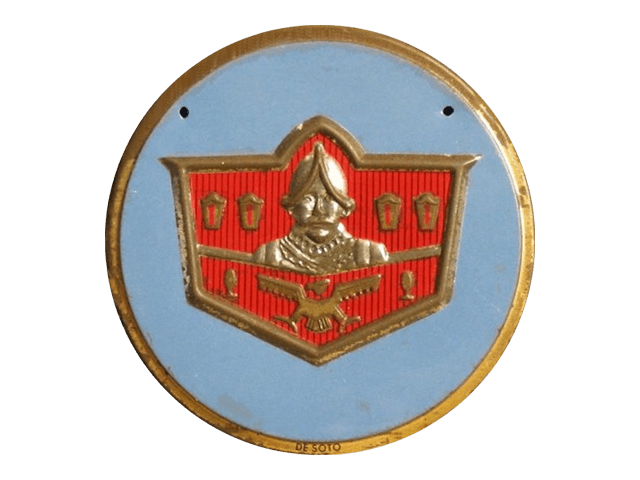
Many DeSoto emblems and hood ornaments depicted the helmeted bust of the 16th-century Spanish explorer Hernando de Soto, after whom the brand was named, honouring his exploratory spirit. Early badges used a heraldic crest based on the Soto coat of arms, while later marks abstracted the theme.
Dodge logo
The current Dodge emblem features two angled red stripes that evoke speed and aggression, replacing the earlier ram's-head badge. The red slashes reflect the brand's muscle-car, high-performance identity.
Donkervoort logo
The Donkervoort badge is a red winged oval carrying the founder's surname in white capitals, the outstretched wings evoking speed and motion on the marque's ultra-light roadsters. It functions chiefly as a signature wordmark of the family-run company.
DS Automobiles logo
The DS emblem fuses the letters 'D' and 'S' into a single interlocking monogram in a shield-like frame, rendered in chrome to signal premium, avant-garde French luxury. The name pays homage to the iconic Citroën DS.
Duesenberg logo
The Duesenberg emblem features a golden eagle with outstretched wings bearing the brand name, with the word 'STRAIGHT' and the numeral '8' referencing the celebrated Duesenberg Straight-8 engine. The eagle and gold tones signalled the marque's pride, prestige and supreme luxury.
Eagle logo
The Eagle badge depicted a stylised eagle's head in profile, a patriotic American symbol of freedom and strength that gave the marque its name. It was rendered minimally in black and white, with white contours forming the bird against a black field.
Edsel logo
The Edsel emblem rendered the brand name in a distinctive slanted script, frequently set vertically on the car's signature 'horse-collar' grille. The mark itself was a stylised wordmark rather than a pictorial symbol.

Faraday Future logo
The Faraday Future logo is an abstract geometric mark forming a stylised 'FF' monogram that suggests motion and forward progress, reflecting the company's electric-mobility ambitions. Its minimalist lines convey a futuristic, tech-forward identity.
Ferrari logo
The emblem depicts a black prancing horse (Cavallino Rampante) on a yellow shield, with the letters S F for Scuderia Ferrari and the Italian tricolor stripe above. The prancing horse was adopted from WWI fighter ace Francesco Baracca, and the yellow background is the color of Modena, Enzo Ferrari's birthplace.
Fiat logo
The current logo (2020) is a simple red 'FIAT' wordmark, an acronym for Fabbrica Italiana Automobili Torino (Italian Automobile Factory of Turin). Red has long been central to Fiat's brand identity.
Fisker logo
The Fisker logo pairs a wordmark of the company name (after founder Henrik Fisker) with an emblem whose two vertical lines represent the designer's pencil and the engineer's ruler. Its orange-and-blue palette was inspired by a sunset over the Pacific Ocean.
Ford logo
The logo is the company name 'Ford' in white flowing cursive script set within a blue oval. The script echoes founder Henry Ford's signature style, and the blue oval, introduced in 1927, has become the brand's enduring identity.
Foton logo
The Foton badge is a silver downward-pointing 'Brilliant Diamond' formed from three angled segments, likened to a sparkling diamond to suggest precision and technological innovation, typically paired with the company name in blue capitals. Blue and silver convey reliability and industrial strength.
Geely logo
Geely's modern emblem is a blue shield filled with radiating lines that evoke an expanding cosmos or interconnected pathways, symbolising the company's global ambitions and the universe of mobility. Earlier badges paired the name with a stylised motif said to echo the mountains around its founding city.
Genesis logo
The emblem features a winged crest with two outstretched wings flanking a central shield bearing the Genesis name, conveying flight, motion, and luxury. The symmetrical wings symbolize balance and the brand's aspiration toward refined, dignified design.
Geo logo
The Geo badge rendered the brand name in lower-case lettering, often accompanied by a globe-like motif reflecting the 'Geo' (earth) name and the marque's small, economical, globally sourced cars. The mark was derived from a Chevrolet-style globe outline and read as a friendly, straightforward wordmark.
Ginetta logo
The Ginetta identity is a wordmark rather than a pictorial emblem, with a distinctive stylised 'G' and modern lettering meant to evoke speed and the firm's motorsport focus.
GMC logo
The logo consists of the bold block letters 'GMC' (from General Motors Truck Company) in red, historically set within a rectangular badge. The strong red lettering emphasizes the brand's rugged trucks and professional-grade vehicles.
Great Wall logo
The emblem is a red oval enclosing a stylised graphic of a Great Wall watchtower, referencing the company's name and Chinese heritage.
Haval logo
The Haval emblem is a stylized metallic badge of the brand name; the brand promotes 'HAVAL = HAVE ALL' as a marketing backronym. The chrome design conveys a premium SUV-focused identity for the Great Wall Motors sub-brand.
Hennessey logo
The Hennessey emblem centres on a stylised 'H' monogram on a black field, usually set within a circular band bearing the Hennessey name, evoking high performance and speed.
Hino logo
The Hino mark is a stylised letter 'H' that also reads as a sun rising over the horizon, symbolising the company's drive to take on new challenges; the logo is rendered in Hino's signature red.
Hispano-Suiza logo
The emblem combines elements of the Spanish and Swiss flags - reflecting the firm's Spanish-Swiss heritage - and is associated with a stork mascot derived from the insignia of a French WWI fighter squadron whose aircraft used Hispano-Suiza engines.
Holden logo
The emblem depicts a stylized lion rolling a stone, referencing an ancient legend that observing lions roll stones inspired humans to invent the wheel. The lion-and-stone motif symbolizes the wheel and the company's role in transportation.
Honda logo
The automobile logo is a stylized chrome letter 'H' for founder Soichiro Honda, set within a rounded trapezoidal frame. The clean metallic design represents the company's engineering and quality.
Hongqi logo
Hongqi means 'Red Flag', and the emblem depicts a stylised fan of red flags, a symbol of Chinese socialist heritage and national pride.
HSV (Holden Special Vehicles) logo
The HSV badge is a black roundel with a red outline enclosing a stylised lion's head beside a man in a racing helmet, nodding to parent Holden's lion emblem and signalling its high-performance role.
Hudson logo
Early Hudson emblems used an inverted triangle - echoing the shape of period radiators - said to represent quality, beauty and reliability, and later badges incorporated ship and tower motifs nodding to the explorer Henry Hudson.

Hummer logo
The original logo is the word 'HUMMER' in bold, blocky capital letters. The rugged, military-derived typography reflects the brand's origins in the High Mobility Multipurpose Wheeled Vehicle (Humvee), a civilian version of which launched in 1992.
Hyundai logo
A slanted, stylized 'H' enclosed in an oval, representing the company initial. The italicized H is also said to symbolize two people (company and customer) shaking hands, with the oval evoking the brand's global expansion.
Infiniti logo
An oval with two lines converging toward a central point near the top, evoking a road stretching toward the horizon and infinity. It symbolizes the endless road ahead and the brand's pursuit of limitless aspiration.
Isuzu logo
The Isuzu logo is formed of two stylised pillars derived from the first character of its name; 'Isuzu' means 'fifty bells' and refers to the Isuzu River near Japan's Ise Grand Shrine.
Iveco logo
The Iveco identity is a wordmark whose stylised lettering conveys industrial strength; the current version pairs black letters with a blue accent on the 'E' for the commercial-vehicle brand.
Jaguar logo
A leaping jaguar (the 'Leaper') captured mid-pounce, symbolizing grace, power, and speed. The accompanying wordmark and growler (a snarling jaguar head) reinforce the predatory agility associated with the brand.
Jeep logo
A simple wordmark spelling 'Jeep', historically paired with the iconic seven-slot grille and round headlights. The seven-slot grille is the brand's defining visual signature, evoking its rugged off-road heritage.
Jensen logo
The Jensen emblem is a winged badge centred on a circular motif bearing the Jensen name, with the wings symbolising speed and grand-touring elegance.
Karma logo
The Karma badge is a circular emblem - a silver ring with a diagonal cut enclosing a deep blue centre with an orange-red outline - inspired by an eclipse and the sun, projecting a luxury electric-vehicle identity.
Kia logo
A stylized, continuous-line signature-style 'KIA' wordmark introduced in 2021, designed with a rhythmic upward motion. It conveys confidence, modernity, and the brand's forward-looking transformation.
Koenigsegg logo
A shield based on the von Koenigsegg family coat of arms, with a blue upper field and a lower red-and-gold diamond (lozenge) pattern. Later cars also carry a ghost emblem honoring the Swedish Air Force squadron once based at the company's factory site.
KTM logo
The wordmark renders "KTM" in bold letters set against an orange slanted, banner-like block, orange being the brand's signature racing colour. The simple, aggressive typography reflects the company's focus on performance motorcycles and motorsport.
Lada logo
An oval enclosing a stylized Volga rowing boat (a 'ladya'), referencing the brand name and the Volga River near the factory. It symbolizes the vessel's journey and the region's heritage.
Lamborghini logo
A golden charging bull on a black shield, reflecting founder Ferruccio Lamborghini's Taurus zodiac sign and his passion for Spanish fighting bulls. The bull symbolizes power, strength, and aggression.
Lancia logo
A blue shield-and-flag emblem historically featuring a steering wheel and a lance, referencing the founder's surname Lancia ('lance'). The flag bears the company name, evoking medieval heraldry and Italian craftsmanship.
Land Rover logo
A green oval badge with the 'LAND ROVER' wordmark, said to be inspired by the smudged outline of a sardine tin left by a designer. It represents the brand's rugged, utilitarian off-road heritage.
Leapmotor logo
The emblem is a stylized abstract "LP" mark, often read as an ascending line suggesting upward, forward motion that echoes the brand's name and its EV ambitions. It is rendered in a clean, modern black-and-white form.
Lexus logo
The Lexus emblem is a stylized letter 'L' set inside an oval, representing the brand name. The oval was carefully proportioned so that the curve of the 'L' aligns precisely with its edges.
Li Auto logo
The badge is a stylized geometric "Li" wordmark in Latin script, where the letters form a forward-leaning, wing- or arrow-like shape suggesting motion. "Li" is read as an abbreviation of "Leading Ideal," while the brand's Chinese name 理想 (Lǐxiǎng) means "ideal" and echoes founder Li Xiang's name.
Ligier logo
The Ligier emblem is built around a winner's-belt-style device with a central buckle carrying the Ligier name, historically paired with French national colours and a checkered racing flag that nod to the marque's French motorsport heritage. Dark blue is the brand's signature colour.
Lincoln logo
The Lincoln emblem is a four-pointed star set within a rectangular frame, often interpreted as a compass-like symbol of direction and guidance. The star reinforces the brand's luxury positioning.
Lotus logo
The Lotus badge is a circular roundel with a green-and-yellow triangle bearing the overlapping initials 'ACBC' for founder Anthony Colin Bruce Chapman, above the word 'Lotus'. The green evokes British racing heritage and the yellow reflects Chapman's optimism for the company's future.

Lucid logo
The current Lucid identity (the company began as Atieva in 2007 and rebranded in 2016) is a minimalist wordmark spelling 'LUCID' in a custom, horizontally stretched sans-serif. It is rendered in monochrome, reflecting the brand's emphasis on clarity and modern electric technology.
Lynk & Co logo
The wordmark presents "Lynk & Co" in a clean, contemporary typeface emphasizing the idea of connectivity and a community of users implied by the brand name. Its minimalist black-and-white styling underlines the brand's tech-forward, digitally native positioning.
Mack Trucks logo
The hood ornament and emblem depict a bulldog (gold on trucks with a full Mack drivetrain), symbolizing the toughness and tenacity the brand's heavy trucks became known for. The bulldog nickname was adopted after British soldiers in World War I likened Mack's rugged AC model to a bulldog.
Mahindra logo
The newer "twin peaks" emblem, introduced in 2021, forms an abstract "M" from two angular peaks, representing the group's "Rise" philosophy and a sense of reaching upward, while older badges used the road-and-name styling of Mahindra & Mahindra. The mark conveys progress and the breadth of the conglomerate's mobility business.
MAN logo
The emblem combines the "MAN" letters with a lion motif, the Brunswick (Braunschweig) heraldic lion that entered the logo via MAN's takeover of Büssing in the early 1970s. The lion symbolizes strength, reflecting the brand's commercial-vehicle and engineering identity.
Maserati logo
The Maserati emblem is a trident, inspired by the statue of Neptune in the Fountain of Neptune in Bologna's Piazza Maggiore, symbolizing strength and vigor. It was adopted by the Maserati brothers as a tribute to their home city.
Maybach logo
The Maybach emblem features two interlocking, mirrored 'M' letters enclosed in a curved-sided triangle, commonly read as standing for 'Maybach-Motorenbau'. The double-M monogram conveys the brand's heritage in ultra-luxury automobiles.
Mazda logo
The current Mazda emblem is a stylized winged 'M' set within an oval, the wings suggesting flight, motion, and the brand's vision for the future. It also evokes a stretched 'V' shape symbolizing creativity and continuous growth.
McLaren logo
The McLaren emblem is the 'Speedmark', a swoosh evoking the airflow and vortices off a race car's rear wing, rendered in the brand's signature papaya orange. The papaya color honors the livery first used by founder Bruce McLaren's racing team.
Mercedes-AMG logo
The AMG crest depicts an apple tree beside a stream, representing Affalterbach (literally "apple tree" and "stream"), the village where the company is based, alongside a cam, valve and valve spring symbolizing its engine-building craft. It is often shown with the Mercedes three-pointed star, signifying high-performance versions of Mercedes-Benz cars.
Mercedes-Benz logo
The Mercedes-Benz emblem is a three-pointed star within a ring, representing the company's ambition for motorization on land, on water, and in the air. The star originated with Daimler and was combined with Benz's wreath after the 1926 merger.
Mercury logo
The brand was named after Mercury, the Roman messenger god associated with speed and commerce, and later badges used a stylized head or an angular "M" mark. The name evokes swiftness and dependability for Ford's mid-priced marque.
MG logo
The MG badge displays the overlapping letters 'MG' within an octagonal outline, standing for 'Morris Garages', the brand's origin. The octagon has been a defining MG identity element since the 1920s.
Mini logo
The Mini logo places the word 'MINI' inside a circle flanked by two stylized wings, symbolizing freedom, speed and the brand's classic British motoring heritage.
Mitsubishi logo
The Mitsubishi 'three diamonds' emblem (the name means 'three diamonds' in Japanese) merges the three-leaf crest of the Tosa Clan with the three stacked rhombi of founder Yataro Iwasaki's family crest, symbolizing reliability, integrity and success.
Morgan logo
The badge features stylized wings flanking the Morgan name, evoking speed and the company's early aviation-inspired styling cues. The winged emblem reflects the marque's sporting, hand-built heritage.
Morris logo
The Morris badge presents the name on a ribbon-style device above an ox fording a river, the emblem of the company's home city of Oxford as used in the city's coat of arms. The mark ties the marque to its English city of origin.
Nikola logo
The brand uses a spaced-out 'NIKOLA' wordmark in a custom sans-serif alongside a hexagonal 'N' symbol (the hexagon evoking the structure of graphite); the name honors inventor Nikola Tesla.
NIO logo
The NIO emblem is split into two halves: the upper curve represents the sky, openness and vision of the future, while the lower shape represents the road or earth, conveying forward action and direction.
Nissan logo
The Nissan logo sets the company name across a circle; historically the circle evoked the rising sun and the bar carried the brand name, reflecting the founder's motto that sincerity and effort 'penetrate even the sun'.
Noble logo
The badge centers on the 'Noble' name in clean block lettering, reflecting the marque's focus on lightweight, driver-focused British sports cars.
Oldsmobile logo
The later emblem features a stylized rocket piercing an oval, reflecting the brand's mid-century association with its 'Rocket' V8 engines and space-age styling, while earlier badges used an ornate crest.
Opel logo
The Opel 'Blitz' (German for lightning) logo depicts a horizontal lightning bolt within a circle. It derives from the emblem of the Opel Blitz truck and symbolizes speed and energy.
Packard logo
The crest pairs a hexagonal shield with a pelican drawn from the Packard family heraldry, signaling the luxury marque's heritage and family lineage.
Pagani logo
The Pagani logo is a silver oval bearing the 'Pagani Automobili Modena' name with a blue accent, reflecting founder Horacio Pagani and the marque's identity as an exclusive Italian hypercar maker near Modena.
Panoz logo
The 'swirling crest,' designed by Daniel Panoz, uses interlocking red and blue swirls echoing a yin-yang of balance and symmetry, with the red, white and blue underscoring the firm's American identity.
Perodua logo
The emblem features a stylized 'P' formed from flowing curves, representing the company name and conveying motion; the marque is associated with its signature green branding.
Peugeot logo
The Peugeot logo depicts a standing lion, used since the 19th century to represent the strength, sharpness and flexibility of the company's saw blades, later modernized into a heraldic lion's-head emblem.
Pininfarina logo
The logo sets the Pininfarina name in an elegant blue script beneath a crown-and-'f' monogram, conveying the design house's prestige and its long heritage of coachbuilding.
Plymouth logo
The emblem depicted the Mayflower ship, referencing the Pilgrims' landing at Plymouth Rock and evoking value, durability, and American heritage.
Polestar logo
The Polestar logo is an abstract mark of two angled chevron-like shapes forming a stylized star, derived from the North Star (Polaris) that gives the brand its name and symbolizing guidance and direction.
Pontiac logo
The Pontiac logo features a downward-pointing red arrowhead (the 'Dart') referencing the brand's namesake, the Native American Odawa chief Pontiac; earlier emblems depicted a Native American head in profile.
Porsche logo
The Porsche crest combines the coat of arms of the former state of Württemberg with Stuttgart's rearing black horse (the city's symbol and home of Porsche, built on former horse-breeding land), signifying the brand's regional heritage.
Proton logo
The badge has featured a stylized tiger's head, a symbol of strength and Malaysian national pride, set on the brand's green-and-blue shield.
Radical logo
The wordmark spells the company name in bold, motorsport-styled lettering, reflecting the brand's focus on extreme track-day and racing cars.
RAM logo
The logo depicts the head of a ram (a male bighorn sheep) with curled horns, symbolizing strength, toughness and surefooted ruggedness fitting for the brand's pickup trucks. The ram's-head emblem was inherited from Dodge before Ram was split off as a standalone Chrysler brand in 2010.
Renault logo
The logo is a diamond (lozenge) shape, a motif Renault has used since 1925. Artist Victor Vasarely redesigned it in 1972 into the interlocking-line op-art diamond that the brand has stylized ever since.
Rimac logo
The logo is a clean wordmark/monogram based on founder Mate Rimac's name, reflecting the brand's modern, high-tech electric hypercar identity.
Rivian logo
The logo pairs a wordmark with a circular emblem containing a horizontal bar, rendered in the brand's signature yellow. It reflects Rivian's positioning around electric adventure and outdoor exploration vehicles.
Rolls-Royce logo
The badge features two overlapping interlocking 'R' letters for founders Charles Rolls and Henry Royce; the monogram was changed from red to black in 1933. The cars are also known for the 'Spirit of Ecstasy' hood ornament, a winged female figure leaning forward.
Rover logo
The badge depicts a Viking longship under sail, playing on the word 'rover' (wanderer) to evoke exploration, strength, and British heritage.
RUF logo
The emblem sets the 'RUF' lettering in a circular crest reminiscent of Porsche-style badges, marking the firm's status as a recognized maker of Porsche-based performance cars; its primary branding is rendered in green.
Saab logo
The emblem shows the head of a crowned griffin within a roundel, taken from the coat of arms of Sweden's Skane (Scania) region. It symbolizes vigilance and heritage and links to Saab's aviation and Swedish roots.
Saturn logo
The emblem is a red square containing two silver curved lines that cross to form a stylized X or swoosh, evoking an orbital path and the planet Saturn after which the brand was named. It was designed to look fresh and modern, distinct from traditional GM divisions.
Scania logo
The badge features a crowned griffin's head, a mythical eagle-lion creature drawn from the coat of arms of the Scania (Skåne) region of southern Sweden, from which the company takes its name. The griffin signifies strength, vigilance and regional pride.
Scion logo
The logo is an abstract, angular 'S' set within an open frame, styled to look modern and edgy for a younger audience. The name 'scion' means a descendant or heir, reflecting the brand's role as an offshoot of Toyota.
SEAT logo
The logo is a stylized 'S' built from angular segments, conveying a modern, sculpted and dynamic look. Since 2017 the brand has used a flat monochrome version of the emblem.
Singer logo
Singer badges typically rendered the 'Singer' name in a flowing script or block lettering, often within a banner or shield-shaped surround, acting as a marque wordmark rather than a pictorial symbol.
Škoda logo
The emblem is a winged arrow within a circle, in use since 1925. The wing symbolizes progress and freedom while the arrow represents technical precision and forward direction.
Smart logo
The logo combines the lowercase wordmark 'smart' with a 'c'-shaped element and an arrow, where the 'c' stands for 'compact' and the arrow signals forward-thinking design. The name derives from Swatch, Mercedes and 'art' (Swatch Mercedes ART).
Spyker logo
The emblem shows a spoked wheel overlaid by a stylized aircraft propeller above the Latin motto 'Nulla tenaci invia est via' ('For the tenacious, no road is impassable'), nodding to the firm's early work building both cars and aircraft.
SsangYong logo
The badge shows a pair of stylized intertwined wings or scrolls; 'SsangYong' means 'twin dragons' in Korean, with the emblem representing two dragons rising together to suggest ascent and strength.
SSC (Shelby SuperCars) logo
The badge is a heraldic shield based on founder Jerod Shelby's family crest, featuring a checkered field, a chevron and the Latin motto 'In Veritate Victoria' ('In truth is victory'); the SSC version uses red, white and blue for the United States.
Studebaker logo
The well-known later emblem was the 'Lazy S', a circular badge split into red and blue halves divided by a raised silver 'S'. Earlier badges emphasized the Studebaker name, reflecting the family wagon business.
Subaru logo
The logo depicts the Pleiades star cluster (called 'Subaru' in Japanese) as one larger star with five smaller stars. They represent the companies that merged to form Subaru's parent, Fuji Heavy Industries.
Suzuki logo
The emblem is a stylized red letter 'S', the initial of the founder's surname, Suzuki, accompanied by the brand name in blue. It simply represents the company name and conveys a sense of dynamism.
Tata logo
The Tata emblem is a stylized 'T' meant to suggest a tree or a fountain, symbolizing a fountain of knowledge and a sheltering tree of trust. The mark was developed with branding agency Wolff Olins to convey trust and fluidity.
Tatra logo
The badge presents the 'TATRA' wordmark, with the marque named after the Tatra Mountains. The brand and name came to symbolize ruggedness and durability suited to demanding terrain.
Tesla logo
The emblem is a stylized letter 'T' for Tesla, designed to evoke a cross-section of an electric motor, with the main 'T' representing a segment of the rotor and the curved line above representing part of the stator. The brand is named after inventor Nikola Tesla.
Toyota logo
The emblem consists of three overlapping ellipses: the two perpendicular inner ovals form a stylized 'T' for Toyota and symbolize the hearts of the customer and the product, while the surrounding outer oval represents the world embracing Toyota and the global expansion of its technology.
Triumph logo
Triumph car badges varied over time, in earlier eras often taking the form of a blue shield or a globe motif carrying the 'Triumph' name, reflecting the brand's slogan 'Triumph All Over The World' and a sense of victory in keeping with the name.
TVR logo
The TVR badge is a stylized wordmark in distinctive elongated, italicized lettering; the name comes from founder TreVoR Wilkinson's first name, with the letters T, V and R drawn from it. It is a typographic emblem rather than a pictorial one.
Vauxhall logo
The logo depicts a heraldic griffin, a mythical creature with the body of a lion and the head and wings of an eagle. It derives from the coat of arms of Fulk le Breaute, a 13th-century soldier whose London estate, Fulk's Hall, gave the Vauxhall district and the company its name.
VinFast logo
The emblem is a monogram letter 'V' formed by two angled silver strokes (chevrons) converging upward. The 'V' is officially tied to 'Vietnam' and also references the brand name (Vingroup + Fast), with the rising shape meant to suggest progress, speed and aspiration.
Volkswagen logo
The logo is a monogram of the interlocking letters 'V' and 'W' (for 'Volkswagen', German for 'people's car') enclosed within a circle. The stacked initials simply represent the brand name.
Volvo logo
The emblem (the 'Iron Mark') is the ancient alchemical symbol for iron, a circle with an arrow pointing up to the right, which is also the symbol for Mars, chosen to evoke strength and Sweden's iron and steel heritage. The name 'Volvo' is Latin for 'I roll'.
W Motors logo
The badge is a stylized letter 'W' whose symmetrical, angular form evokes a pair of wings. The 'W' is reported to stand for 'Wolf', after founder Ralph Debbas's childhood nickname, and signals the brand's positioning as a high-end Middle Eastern hypercar maker.
Wiesmann logo
The marque's symbol is a gecko, chosen because the lizard's grip on surfaces mirrors the way the brand wanted its roadsters to 'stick' to the road. The reptile became the company's trademark on its hand-built sports cars and even shapes the roof of its Dülmen factory.
Wuling logo
The traditional Wuling badge is a red 'W' built from five overlapping diamonds (rhombuses). The name 'Wuling' translates as 'five diamonds', and red is associated with prosperity and good fortune in China.
XPeng logo
The emblem is a stylized letter 'X' whose mirrored angular forms evoke wings or rotor blades, reflecting the brand's focus on autonomous and future mobility. 'XPeng' is short for Xiaopeng Motors, named after chairman He Xiaopeng.
Zastava logo
The badge is built around a stylized letter 'Z' for Zastava, whose name means 'flag' or 'banner' in Serbian (echoing the factory's earlier name, Zavodi Crvena Zastava, 'Red Flag Factories'). The classic emblem placed a white 'Z' on a green oval.
Zeekr logo
The wordmark presents the brand name 'ZEEKR' in a bold, custom geometric sans-serif typeface. Per the company, 'ZE' stands for Zero, 'E' for Evolving the Electric Era, and 'Kr' for the element Krypton, a gas that emits light when electrified.
Zenvo logo
The wordmark renders 'ZENVO' with the tail of the 'Z' underlining the name, set above a dark geometric emblem (variously read as a stylized locomotive front or a Thor's-hammer Mjölnir motif nodding to the brand's Scandinavian roots). The name itself derives from founder Troels Vollertsen's surname rather than simply the letter 'Z'.
Frequently asked questions
What do car logos mean?
Most car logos encode something about the brand's origin — a founder's initials (Honda's H, Bentley's winged B), a city or region's heraldry (BMW's Bavarian colours, Porsche's Stuttgart horse), or an animal chosen for power and speed (Ferrari's prancing horse, Lamborghini's bull).
Which car logo is a horse?
Ferrari's prancing horse and Porsche's rearing horse are the most famous. Both trace back to local heraldry and history rather than to each other.
What do the four rings on the Audi logo mean?
The four interlocking rings represent the four companies — Audi, DKW, Horch and Wanderer — that merged in 1932 to form Auto Union, Audi's predecessor.